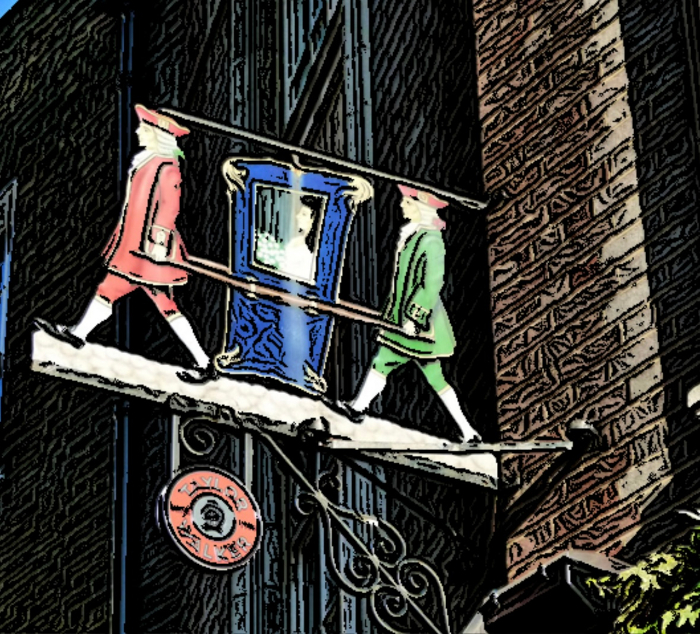
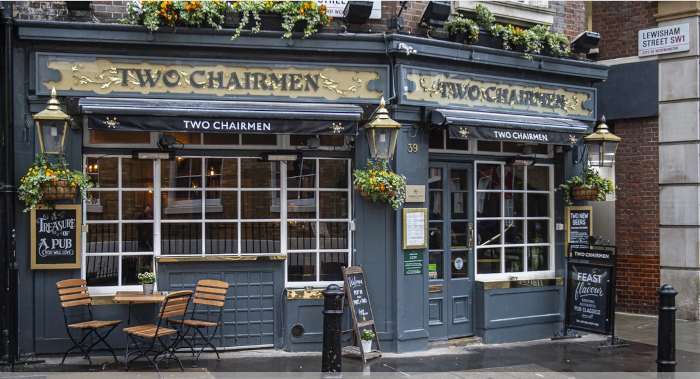
Tucked away on Dartmouth Street near St James’s Park in Westminster, the Two Chairmen pub provides more than just a cozy watering hole. This pub is a living relic of 18th-century London, dating back to before 1729, making it one of the oldest public houses in the area.
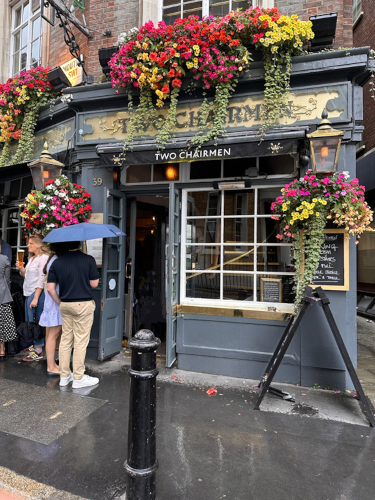 Situated near St James’s Park, Big Ben, and Westminster Abbey, the Two Chairmen pub provides an ideal gathering spot for both tourists and locals.
–
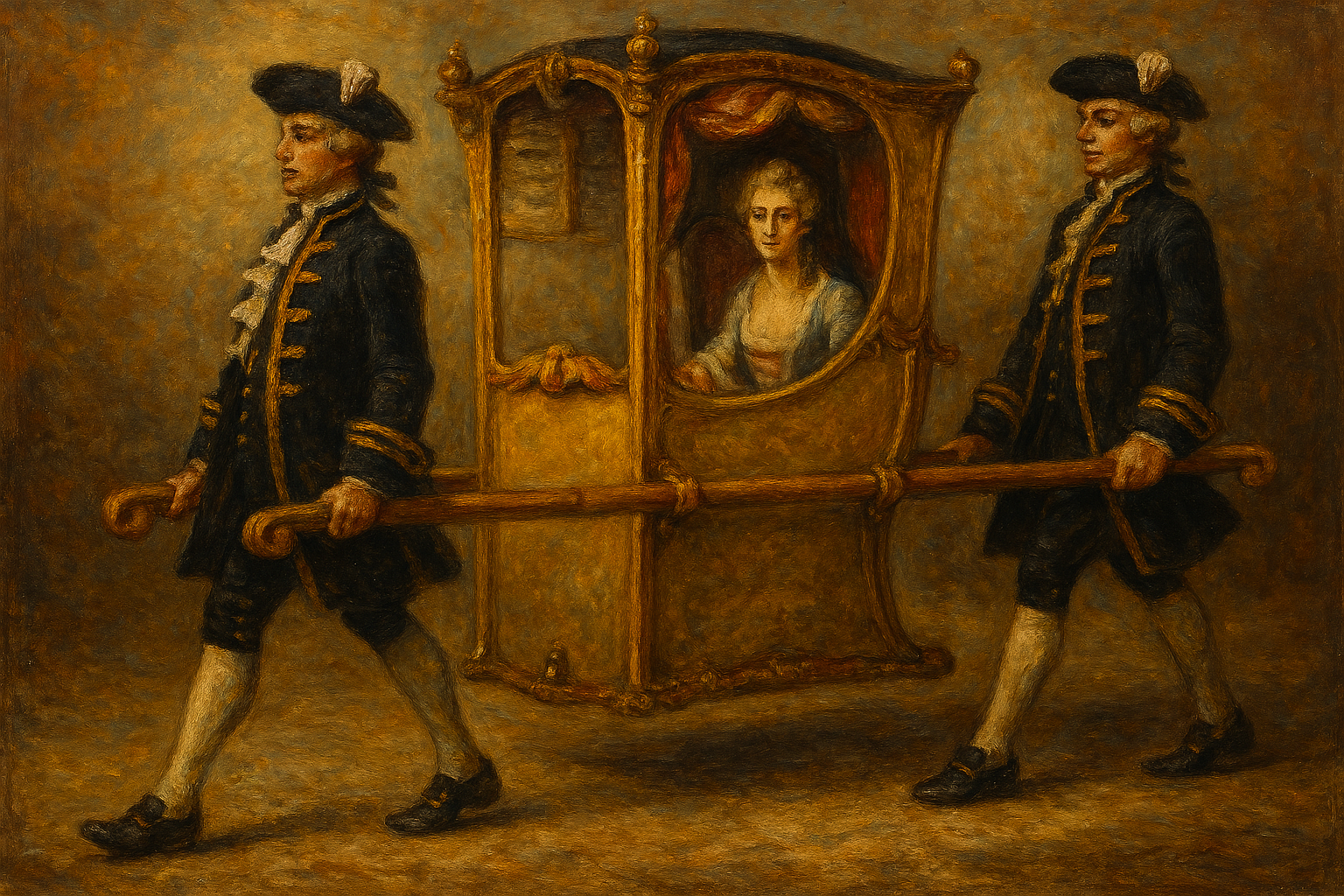
Moreover, the Two Chairmen provides a time portal view of a fascinating aspect of 18th-century transportation. The pub’s name refers to the two men—known as “chairmen”—who used to carry wealthy patrons in sedan chairs. Strong men hoisted the single-seat sedan carriages on poles and bore the occupant through the streets. In Westminster, Chairmen often frequented the Two Chairmen pub while waiting for their next customers.
Chairmen – An Early Version of Taxi and Uber-like Transportation Services
In 18th-century London, chairmen played a vital role in urban transportation—especially for the wealthy and elite. Here’s how their job worked and why it mattered.
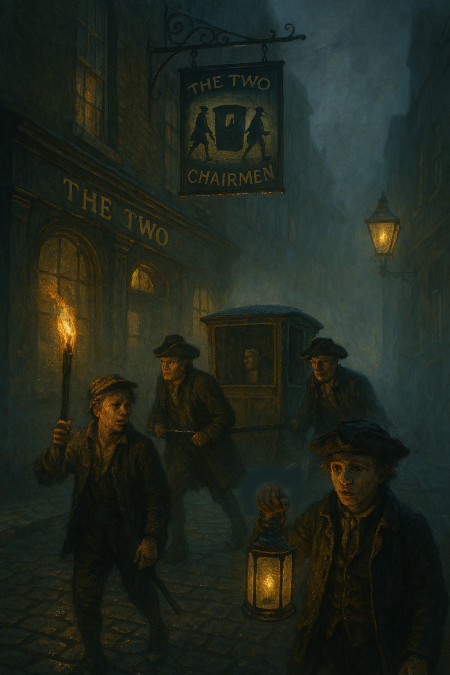 Chairmen in 18th-century London didn’t directly shape the public transport system as we know it today. But they played a foundational role in its evolution.
–
What Chairmen Did
Chairmen carried sedan chairs, consisting of enclosed, single-passenger carriages mounted on poles. These chairs were manually lifted and transported by two strong men—the chairmen—who walked in tandem. Much like a private taxi or Uber-like service, aristocrats, politicians, and fashionable society members used the service to navigate crowded or muddy streets.
Operation and Service
Chairmen were commonly found near theaters, government buildings, and venues like the Royal Cockpit (a cockfighting arena that was located near the Two Chairmen pub). There is some evidence that blue posts located outside advertised these sedan chair stations.
The chairmen waited outside or inside pubs (like the Two Chairmen) for fares, making these establishments informal dispatch centers. Folklore exists that the shout “Chair ho!” used to hail a sedan might have evolved into the British farewell “cheerio”. However, there’s no factual evidence of this myth.
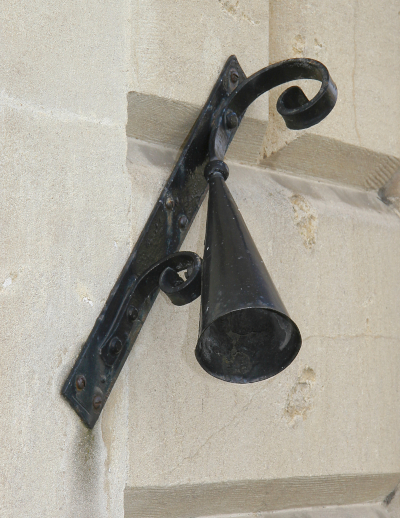
While walking in London, you may discover a relic from the past. Link boys used “snuffers” to extinguish their torches. Photograph courtesy of Michael Maggs via Wikipedia and licensed by Creative Commons.
–
Historical Tidbit: The phrase “can’t hold a candle to” means someone or something is vastly inferior to another. Its roots trace back to the 16th and 17th centuries, when holding a candle was a menial task—often assigned to apprentices or link boys. In some accounts, the idiom may even derive from bad link boys—those who couldn’t be trusted to light the way properly or who led clients into danger. If someone couldn’t properly light the way, they were considered unfit even for the lowest role.
–
Social Status
Chairmen performed physically demanding and low-status work. However, high-profile and wealthy patrons entrusted them to provide a secure transportation service. Local authorities and regulations required chairmen’s licensing, adding a layer of professionalism to their trade. And chairmen often wore uniforms to demonstrate their expertise and establish their respectability.
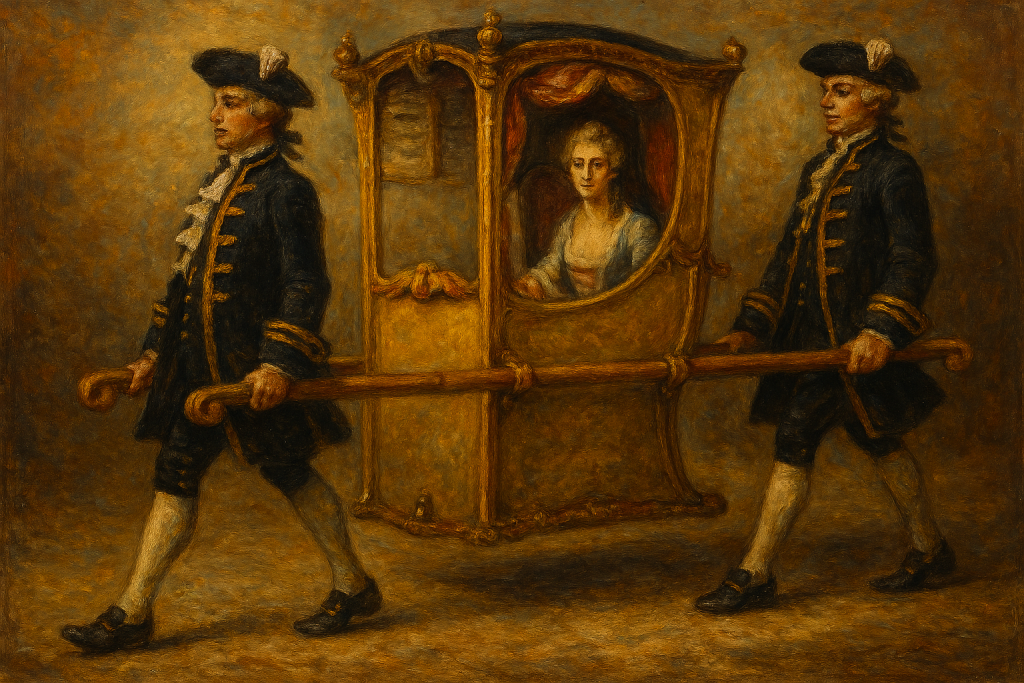 Sedan chairs weren’t just transport—they were a social stage, a status symbol, and a solution to urban chaos.
–
Sedan chairs became a symbol of societal class struggle. William Hogarth’s (an English painter, cartoonist, and satirist) famous series “Four Prints of an Election” includes an illustration (called Chairing the Member) showing a jubilant political candidate being paraded through the streets in a sedan chair. The scene is chaotic and humorous, filled with visual satire—one chairman is nearly collapsing under the weight, while another struggles to keep balance. The illustration captures not only the physical labor of chairmen but also the social spectacle of public transport and politics in Georgian England.
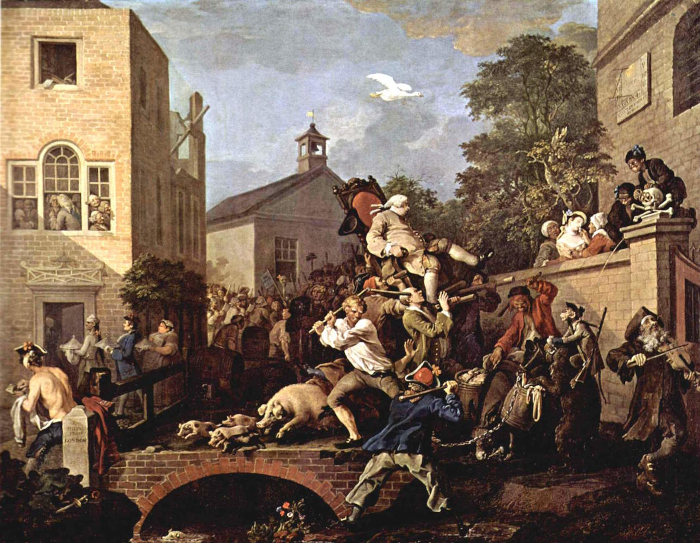 Chairing the Member by William Hogarth
–
Why They Were Popular
London’s streets were often filthy, unpaved, narrow, and dangerous—especially in bad weather. Sedan chairs offered a cleaner, safer, and more private alternative to walking or riding in open carriages.
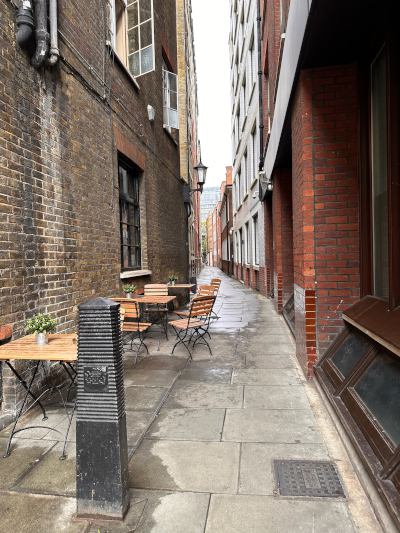 Located along the side of the pub, this alley demonstrates how narrow thoroughfares can be.
–
Origin and Regulation
The concept of human-powered transport dates back to ancient civilizations. In China, the jiao (a Chinese sedan chair) was used as early as the Tang Dynasty (618–907 AD). Similar conveyances existed in ancient Rome and Egypt, often reserved for the elite or religious figures.
Historians generally agree that the term “sedan chair” comes from the town of Sedan, France. While the exact origin is debated, the connection to the town of Sedan is widely accepted as the source of the name.
Sir Saunders Duncombe introduced sedan chairs for hire in London in 1634, securing a 14-year license to operate what were essentially the first “hackney chairs” (sedan chairs available for hire). His entrepreneurship helped popularize the use of chairmen and set the stage for their widespread presence in London’s streets and elsewhere in England. In places like Bath and Cheltenham, sedan chairs were favored by invalids and fashionable ladies, offering direct transport from bedchamber to bath.
City authorities imposed rules on chairmen’s conduct, including approved routes, fare schedules, and uniform requirements. Violations could result in fines or loss of license. Effectively, chairmen were semi-organized urban service providers, blending independence with light regulation—much like early cab drivers before the rise of taxi companies.
Decline
For a time, sedan chair services functioned as indispensable urban transportation fixtures. However, better infrastructure and roads, expanded city limits, growth of wheeled transportation, changes to social norms, increased labor costs, and industrialization all contributed to the demise of the chairmen’s services. In short, sedan chairs were outpaced by innovation, outmoded by changing values, and outclassed by more efficient systems. They’re a perfect case study in how transport reflects—and shapes—the society it serves.
The Two Chairmen Pub Today
Today, an asphalt road and a level cement sidewalk front the Two Chairmen pub. A short walk takes you to the St. James tube station. A taxi, Uber car, or other car service can easily take you to or from the pub. My wife and I walked in light rain from our hotel to the pub with no worry about mud or filthy streets.
 18th-century charm awaits inside. Photograph courtesy of Greene King.
–
Even so, echoes from the past still reverberate throughout the street. Although not currently painted blue, there are two posts in front of the pub. Signs outside the pub provide a brief explanation of the pub’s name. Across the street and about 70 steps away, you can find Cockpit Steps – a hidden alley and stairway leading to Birdcage Walk and the spot where cock fights occurred in the 1700s. The steps are the last remaining parts of the old Royal Cockpit.
Greene King currently owns and operates the pub. Greene King’s Pub & Restaurant Division manages a wide portfolio of historic and contemporary pubs across Britain. Their business focus centers on preserving traditional charm while offering modern hospitality.
Rebuilt in 1756 and now designated a Grade II listed building, Two Chairmen preserves original features like wooden ceiling beams, leaded windows, ornate fireplaces, and murals, offering a tangible link to London’s 18th-century architecture and decor.
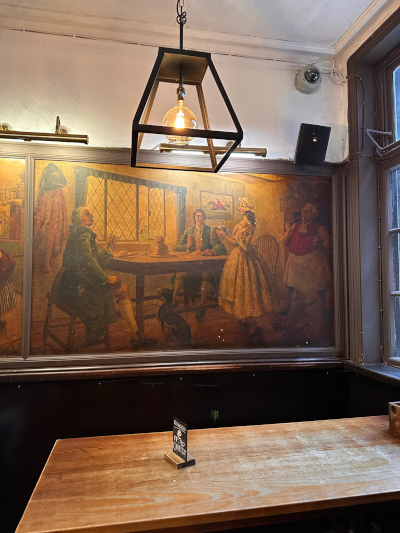 A mural captures pub patrons of the 18th century.
–
Because of its proximity to the Houses of Parliament, the pub has also seen its fair share of politicians, authors, and other prominent citizens over the years. The pub has been referenced in literature and memoirs, including works by John Rae, A.N. Wilson, and Michael Dobbs, often providing the backdrop for political or personal drama. Also, the pub appears in films like Mary Poppins Returns and Keep the Aspidistra Flying, reinforcing its role as a visual and symbolic icon of London life.
Today, Two Chairmen provides a dog-friendly, family-friendly atmosphere, seasonal menus, and function rooms, blending tradition with contemporary hospitality. The upstairs bar is available for private hire. A little off the tourist trail, civil servants who work locally frequent the pub. The pub is small, often crowded, and you may have to stand outside.
The pub features six handpumps that serve cask-conditioned ale or cider. Their cask service is Cask Marque accredited by the Campaign for Real Ale (CAMRA) organization, assuring the highest quality maintenance and service of cask-conditioned ales.
The Two Chairmen pub’s combination of history, charm, atmosphere, food, drink, and service offers a great stop while exploring London. In essence, The Two Chairmen is more than a pub—it’s a living museum of London’s social evolution, where transport, politics, literature, and leisure converge.